

Enhancing Time-Resolved X-ray Experiments with Hadamard Timing:
Employing the WaveGate Pulse Picker to generate patterned X-Ray Pulse trains
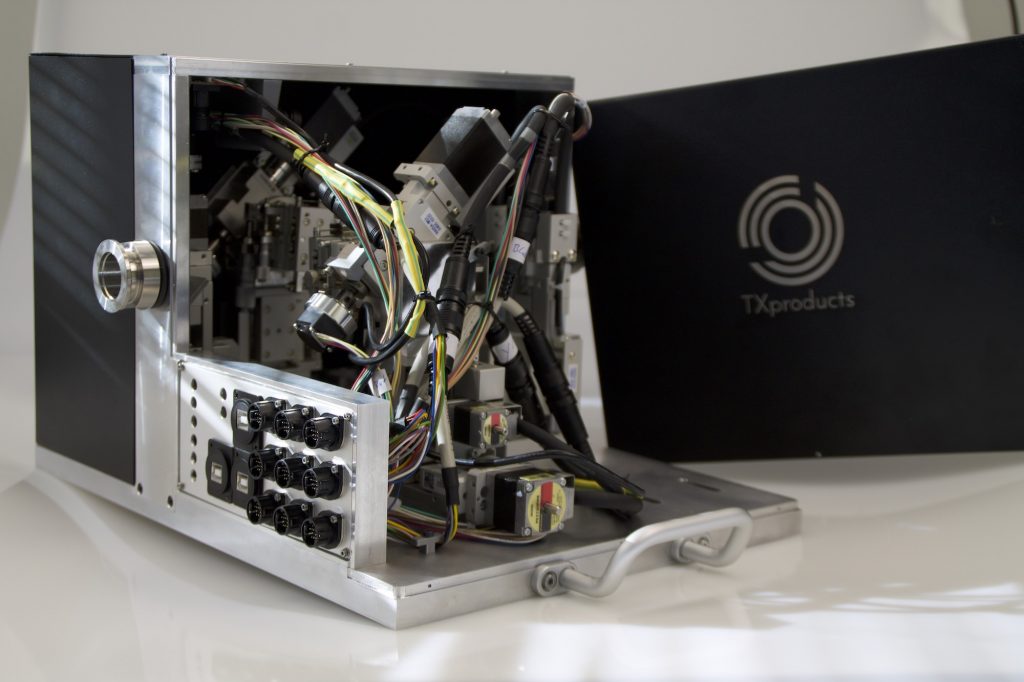
WaveGate Pulse Picker: Enabling Complex Timing Schemes
The WaveGate is a solid-state, programmable pulse picker that modulates the time structure of synchrotron X-ray beams. It uses piezoelectric crystals and surface acoustic waves (SAWs) to dynamically control diffraction efficiency, allowing precise gating of X-ray pulses.
Key specifications:
- Switching time: as short as 2 ns
- Diffraction efficiency: up to 30%
- Photon suppression: 10⁻³ to 10⁻⁴ in off-state
- Synchronization: compatible with synchrotron bunch markers
This flexibility allows the WaveGate to generate custom probe sequences, including Hadamard patterns, directly at the beamline control interface.
Hadamard Timing vs. Pump-Probe: A Comparative Overview
In pump-probe experiments, each delay time is probed individually, requiring multiple measurements and resulting in low photon efficiency. In contrast, Hadamard timing uses multiplexed probe sequences, where each measurement contains information from multiple delay windows. The transient response is reconstructed via an inverse Hadamard transform.
Advantages of Hadamard Timing:
- Higher photon flux per image
- Improved signal-to-noise ratio (SNR) under realistic conditions
- Robustness against drift and noise
- Efficient use of sample lifetime
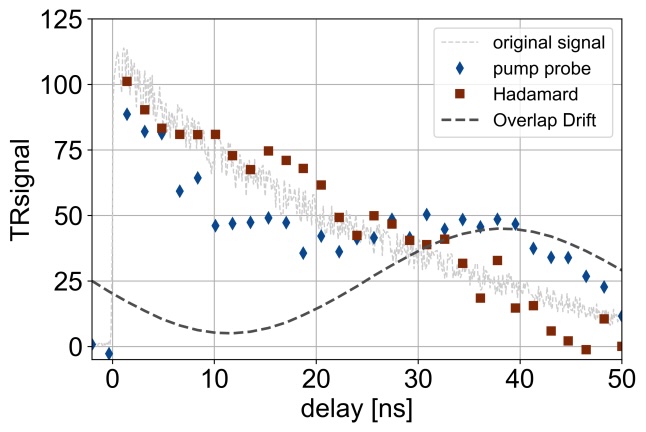
Figure 1: Simulated time-resolved x-ray data using standard pump-probe (blue diamonds) and Hadamard (red squares) timing. The original signal (light gray dashed line) is distorted by a periodic drift (dark gray dashed line), e.g., due to temperature oscillations during the measurement.
Limitations:
- Slightly higher SNR error under ideal conditions
- Requires full dataset for reconstruction
- Sensitive to systematic errors across sequences
Conclusion
The WaveGate pulse picker enables advanced timing schemes like Hadamard encoding, offering a
powerful alternative to traditional pump-probe methods. It provides:
- Higher sensitivity and photon efficiency
- Improved robustness to experimental instabilities
- Flexible integration into beamline environments
This makes it an ideal solution for researchers seeking to push the boundaries of time-resolved X-ray
science.
You can find the original publication here: https://pubs.acs.org/doi/10.1021/acsomega.5c09218