

Demonstrating Ultrafast X-ray Pulse Shortening
PicoSwitch
Time-resolved X-ray diffraction is a powerful technique for probing ultrafast structural dynamics in materials. However, the temporal resolution of synchrotron-based experiments is limited by the intrinsic pulse duration of synchrotron radiation. By installing a photoacoustic Bragg switch called the PicoSwitch, we demonstrated slicing of hard X-ray pulses from ~100 ps to just 7.5 ps, thus enabling the direct observation of picosecond-scale lattice dynamics in thin-film materials.
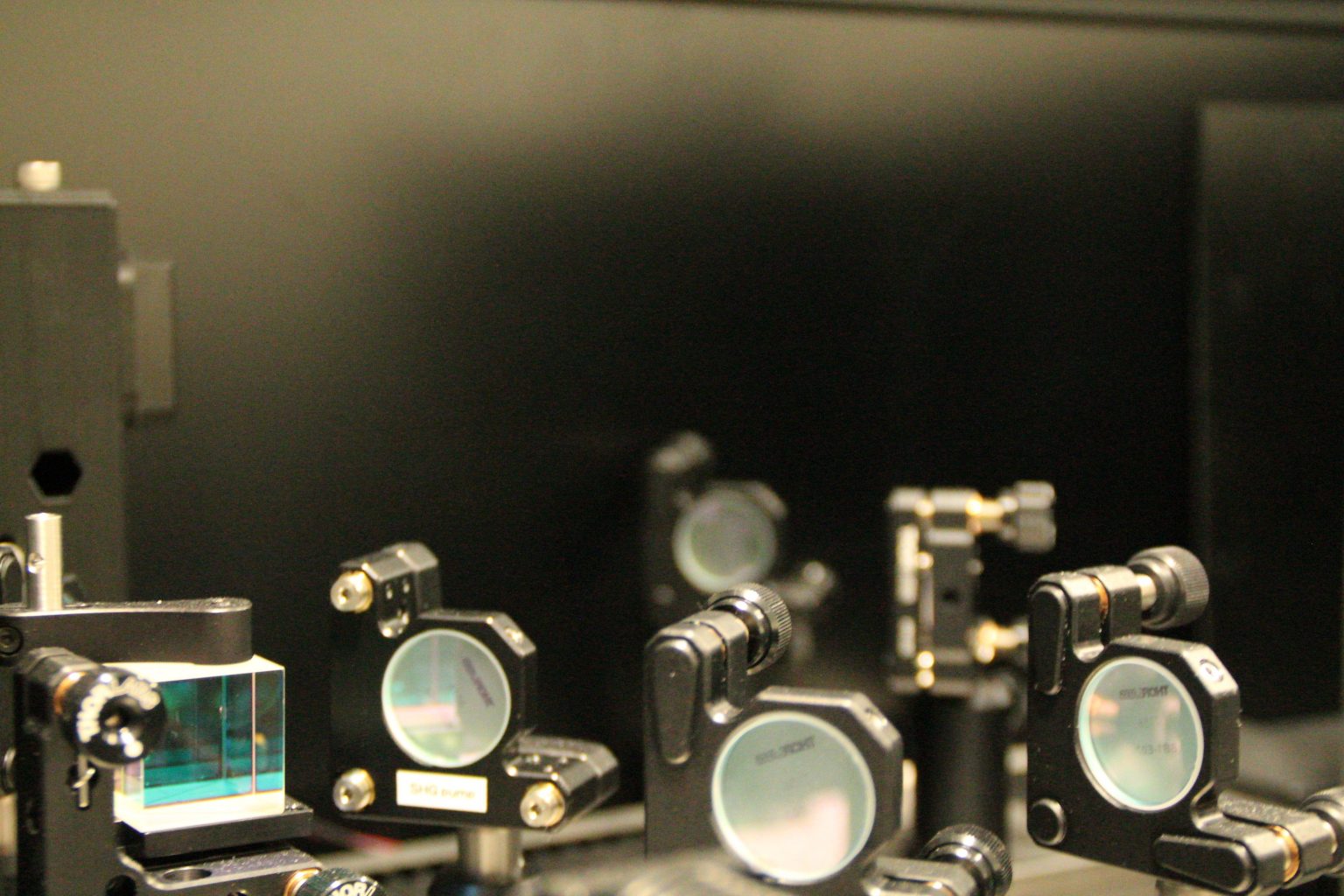
Demonstration Experiment at ESRF
The experiment was carried out on the ID09 beamline at ESRF, where the PicoSwitch was integrated into a pump–probe setup designed to capture the propagation of coherent acoustic phonons—essentially, sound waves—through a layered thin-film sample. Both the PicoSwitch and the sample were constructed from similar materials: a transparent dielectric layer of LaAlO₃ (LAO) atop a metallic La₀.₆₆Sr₀.₃₃MnO₃(LSMO) layer, all grown on a NdGaO₃substrate. These structures were fabricated using pulsed laser deposition to ensure high-quality epitaxial growth. To initiate the measurement, two optical pulse replicas from the same laser source were used. One pulse triggered the PicoSwitch, generating a transient strain wave that modulated the diffraction efficiency of the switch. This modulation acted as a temporal gate, allowing only a narrow slice of the synchrotron X-ray pulse to be diffracted toward the sample. The second optical pulse excited the sample itself, launching coherent acoustic phonons that propagated through the thin-film layers.
Because both the switch and the sample were excited by pulses from the same laser, the timing between the pump and probe was inherently jitter-free. A motorized delay stage allowed precise control over the time delay between excitation and probing, enabling the researchers to map the evolution of the lattice structure with picosecond resolution.
Time-resolved X-ray diffraction measurements revealed clear, step-like shifts in the diffraction peaks of both the LSMO and LAO layers, corresponding to the passage of strain waves. These shifts were not only observed but also quantitatively matched with simulations based on dynamic diffraction theory and acoustic phonon propagation models. The shortened X-ray pulse, with a full width at half maximum of 7.5 ps, provided the temporal resolution necessary to resolve these dynamics.
Additional experiments demonstrated that the PicoSwitch could operate at repetition rates up to 1 MHz and accept a relative bandwidth of 0.2%, delivering photon fluxes on the order of 10⁹ photons per second. Importantly, the insertion of the PicoSwitch did not degrade the beam’s angular resolution or stability, making it a practical and powerful tool for enhancing existing synchrotron beamlines.
Impact and Applications
This demonstration confirms that the PicoSwitch can be integrated into synchrotron beamlines without compromising beam quality, enabling:
High-resolution studies of ultrafast lattice dynamics
Time-resolved investigations in materials science, condensed matter physics, and nanotechnology
Enhanced capabilities for existing synchrotron facilities without the need for XFEL infrastructure
Conclusion
The successful demonstration of the PicoSwitch at ESRF marks a significant advancement in ultrafast X-ray science. By enabling picosecond time resolution in synchrotron-based experiments, the PicoSwitch opens new avenues for exploring dynamic processes in complex materials with high precision and efficiency.
You can find the original publication here: https://pubs.acs.org/doi/10.1021/acsomega.5c09218